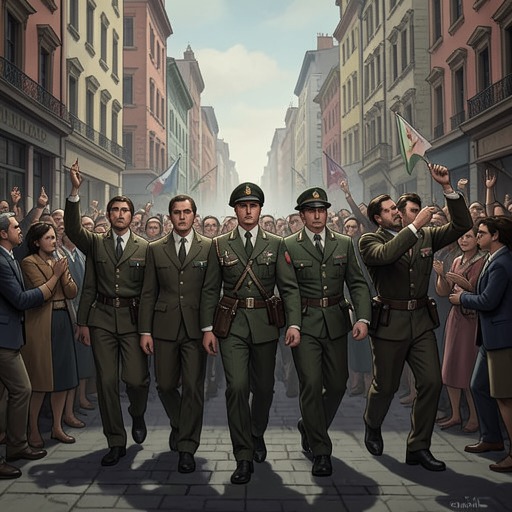
Bardamu’s confrontation with Captain Frémizon
Journey to the End of the NightBardamu’s confrontation with Captain Frémizon is a near-violent reckoning aboard the Admiral Bragueton in which Bardamu escapes punishment by turning accusation into theater. Faced with an officer demanding that he answer for supposedly insulting the colonial passengers, he denies the charge, performs extravagant patriotism, and finally leads his would-be attackers to drink. The immediate danger passes, but the reconciliation remains a fragile performance built on vanity, fear, and the need to survive.
Causes and Background
During the ship’s passage toward Bragamance, Bardamu has withdrawn from the other passengers. He avoids meals and the deck, stops talking, and tries to make himself almost invisible. His cabin steward, a family man, tells him that colonial officers have sworn to slap his face at the first opportunity and throw him overboard. The steward cannot explain what provoked the threat; Bardamu, too, is left without a clear account of what he has done. The hostility appears to have gathered around his face and his silent presence rather than any stated grievance.
The threat takes shape in the enclosed social world of the ship. The officers and passengers have been confined together for weeks, with little to occupy them, and Bardamu observes that ordinary impatience and resentment become more conspicuous at sea. His rare appearances at table acquire the scale of public events: the passengers notice and whisper when he enters. By the time Captain Frémizon confronts him, Bardamu understands that the officers have been brooding over remarks they believe he has made since Marseille, while he has been trying to avoid them rather than challenge them openly.
The Confrontation
Captain Frémizon arrives with four junior officers blocking the doorway. His formal address identifies him as captain of the colonial army and demands an explanation on behalf of his comrades and the ship’s indignant passengers. He accuses Bardamu of making intolerable remarks about them during the voyage and insists that he say openly what he has supposedly been saying in an undertone for twenty-one days. The scene’s ceremonial language leaves little doubt about the danger: Bardamu sees the officer as the embodiment of war, and his escort as the agents of an approaching execution.
Bardamu is relieved that Frémizon is speaking rather than striking. A demand for words, however threatening, gives him an opening to escape. He answers with vehement denials and professes that it is monstrous to suspect him of such contempt. He claims to have fought for France and to have shed his blood alongside the officers, then praises them as heroes preparing to resume their sacred duty in the colonial empire. His speech does not establish what he truly thinks of them; it is a calculated answer to the danger in front of him.
At a pause, Bardamu goes straight to the captain and takes both his hands. Keeping them enclosed, he continues his apology and attributes the apparent insult to his own timidity, which he says may have looked like disdain. He praises the assembled passengers, officers, and women, and asks to be admitted to their patriotic brotherhood. The physical gesture and the torrent of compliments work together: while holding Frémizon’s hands, Bardamu keeps the encounter from turning into a beating and gives the captain an awkward problem to resolve without violence.
A Reconciliation Made of Performance
Bardamu’s address culminates in a patriotic appeal. He raises one arm while retaining the captain’s other hand and cries, “Vive la France! Vive la France!” The slogan creates a moment’s hesitation: the officers may be hostile, but striking a civilian who has just shouted for France is difficult. Bardamu treats that hesitation as the opening it is, reaching into the group to take two officers by the arms and inviting everyone to the bar for a drink in honor of his health and their reconciliation.
The officers resist only briefly. Soon they are drinking together for two hours, while the women look on in silence and apparent disappointment. Through the bar’s portholes, Bardamu sees the schoolteacher-pianist prowling with other women; he suspects that they recognize his escape as a trick and will try to catch him at another turn. The men’s agreement is therefore neither universal nor secure. Bardamu has escaped the immediate threat, not erased the suspicion that produced it.
To keep the peace, Bardamu listens to the officers’ stories of colonial exploits and responds with admiration. He asks for more accounts of their military deeds, finding that the soldiers are ready to provide them. His role is to seem impressed, not to test the stories. Praise lets the officers enjoy their own importance and gives Bardamu a way to remain inside the group without renewing the argument. By the end of the episode they decide he is acceptable, but that acceptance rests on a performance he must continue to sustain.
Significance and Aftermath
The confrontation establishes self-preservation as Bardamu’s immediate priority. He does not defend himself by proving that the accusation is false or by appealing to justice; he seizes the chance offered by the captain’s demand for an explanation and supplies whatever words may keep him alive. His flattery, handclasp, patriotic cry, and invitation to drink are successive means of managing the threat. The episode’s turn is from near-certain violence to temporary safety, achieved not through courage but through a willingness to abandon self-respect when necessary.
That compromise changes Bardamu’s understanding of fear. The narrator later describes his self-respect draining away during the ordeal and says that, afterward, he felt morally lighter and freer. He presents fear as the means that got him out of danger and as a weapon he no longer needed to supplement with other virtues. The scene thus makes cowardice more than a humiliating lapse: it becomes a survival method, though one that requires Bardamu to play the admirer of men he had previously tried to avoid.
The shipboard reconciliation also exposes the instability of colonial solidarity. The officers invoke their comrades, their passengers, and the empire, but Bardamu gains their favor by flattering their vanity and inviting them to tell stories. Their apparent brotherhood can be restored by praise and drink, even though the women remain suspicious and the underlying grievance is never clarified. The incident ends with Bardamu temporarily included, not with the hostility explained or resolved; his safety depends on reading the group’s pride and performing the part it will accept.